Potential-Controlled Selective Electrocatalytic Reduction of Nitrite to Four Different Products #487
Authors
Nia J. Harmon, Jana Jelušić, Jan Paul Menzel, Bo Shang, Conor L. Rooney, Gary W. Brudvig, Victor S. Batista, Hailiang Wang
Abstract
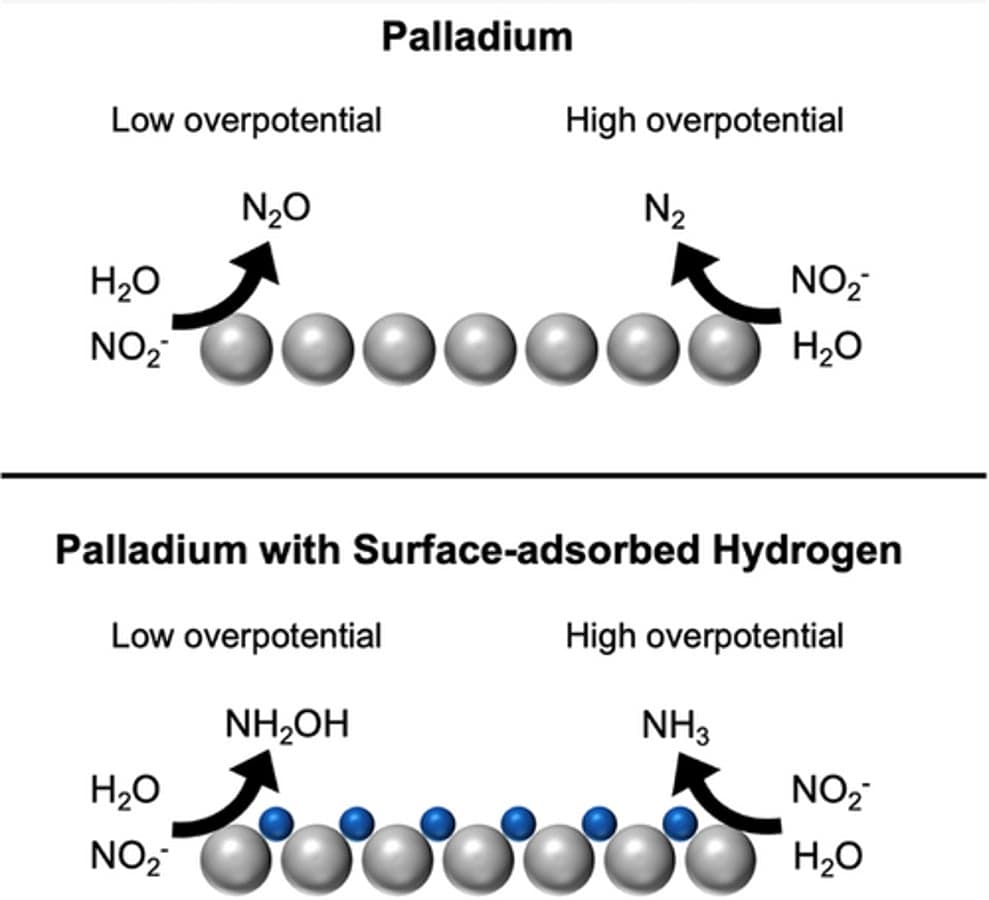
We demonstrate for the first time that Pd metal can convert NO2− to N2O, N2, NH2OH, and NH3 in a near-neutral electrolyte, with high selectivity to each product attained by adjusting the applied electrode potential. Notably, N2 and NH2OH, which are typically difficult to access, emerge as dominant products. Mechanistic investigation combining computational and experimental studies shows that NO2− electroreduction on Pd is controlled by the applied potential and surface coverage of adsorbed H atoms. The interplay of these two factors gives rise to four distinct reaction microenvironments that are consistent with the experimentally observed product distributions. At positive potentials, the pristine Pd surface favors *NO-*NO coupling and N2O production, whereas at less positive potentials, the same surface with more reducing power favors N2. At mildly negative potentials, partial H coverage promotes *NO reduction over coupling and leads to NH2OH production, while at strongly negative potentials, abundant adsorbed H drives complete reduction to NH3. Together, these studies provide insight into the rich reductive chemistry at Pd active sites under electrochemical control and enable the rational design of Pd catalysts for environmental remediation and sustainable chemical synthesis.