Enhanced neutral seawater photoelectrolysis by fast hydrogen pumping at subnanometre triple interfaces #489
Authors
Bingxing Zhang, Kejian Li, Zhuoran Long, Shiyuan Zhou, Deming Xia, Chengjun Sun, Zhengwei Ye, Yuyang Pan, Jan Paul Menzel, Kai Sun, Joseph S. Francisco, Gui-Liang Xu, Victor S. Batista, Zetian Mi
Abstract
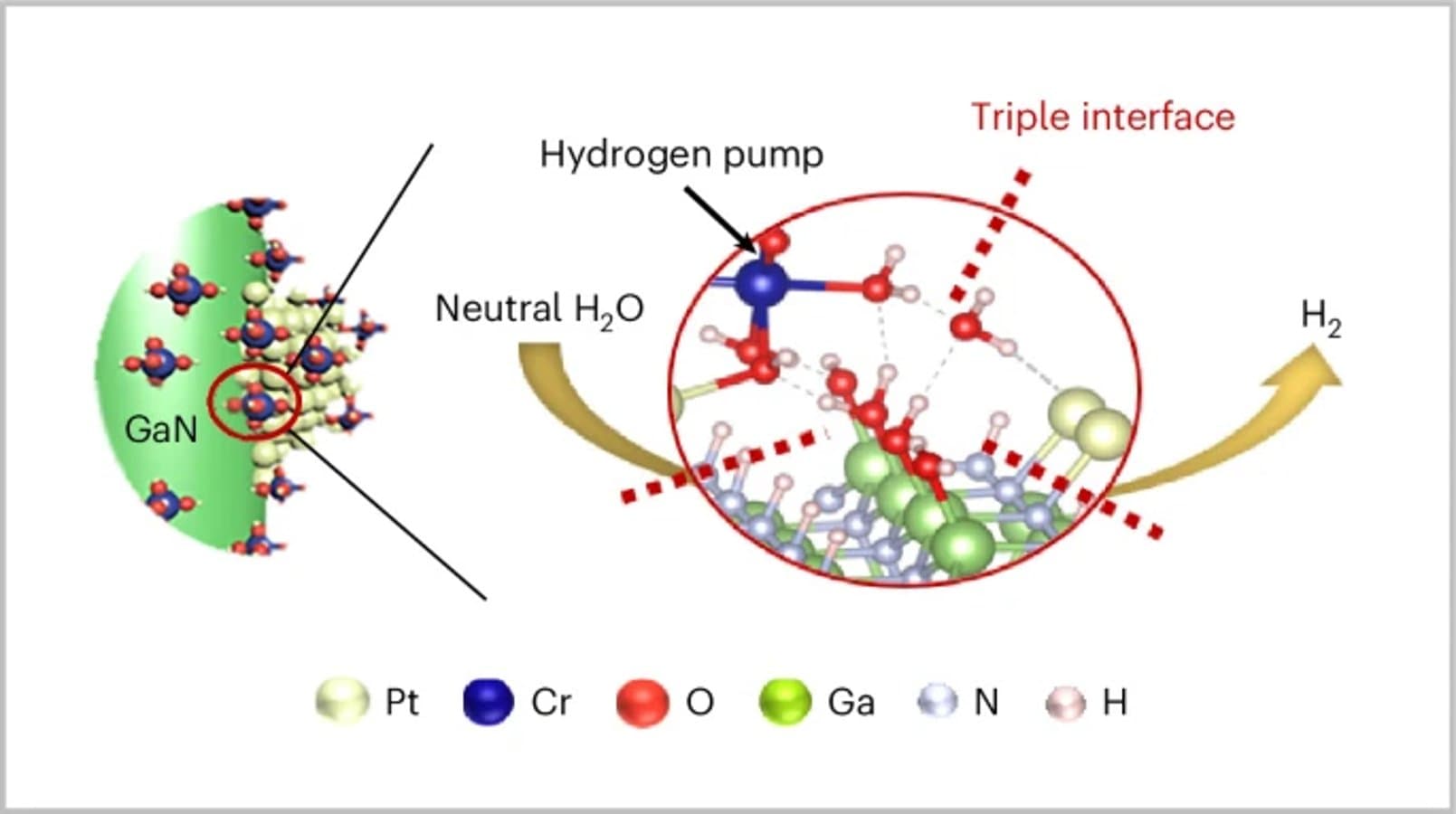
Hydrogen production from neutral water is promising for directly using abundant seawater, yet remains challenging because of sluggish reaction kinetics induced by limited hydrogen supply and transfer to active sites. Here we design a catalyst system consisting of atomically dispersed Cr(OH)x clusters on Pt-decorated GaN nanowires for photoelectrochemical splitting of neutral seawater. The triple-interface architecture (Cr(OH)x–Pt//Cr(OH)x–GaN//Pt–GaN) couples water activation, hydrogen transfer and Pt–H formation across adjacent interfaces, enabling a fast hydrogen pumping process. Through this process, the challenges associated with hydrogen supply and transfer are addressed, surpassing the kinetically limited hydrogen utilization on the conventional single-interface systems. A photocurrent density of around 100 mA cm⁻2 and more than 50 h of operational stability are achieved under neutral saline conditions with concentrated sunlight at 0 V versus the reversible hydrogen electrode. In a hydrazine-assisted seawater photoelectrolyser, the photocathode enables a bias-free photocurrent density of ~70 mA cm−2. This work establishes multi-interface hydrogen management as a promising strategy towards practical hydrogen production.