Strong Coupling of CdSe Quantum Dots to Single-Walled Carbon Nanotubes #477
Authors
Mengyao Bao, Facheng Guo, Seyla Azoz, Nebojsa S. Marinkovic, Matthew Y. Sfeir, Yulian He, Victor S. Batista, Lisa D. Pfefferle
Abstract
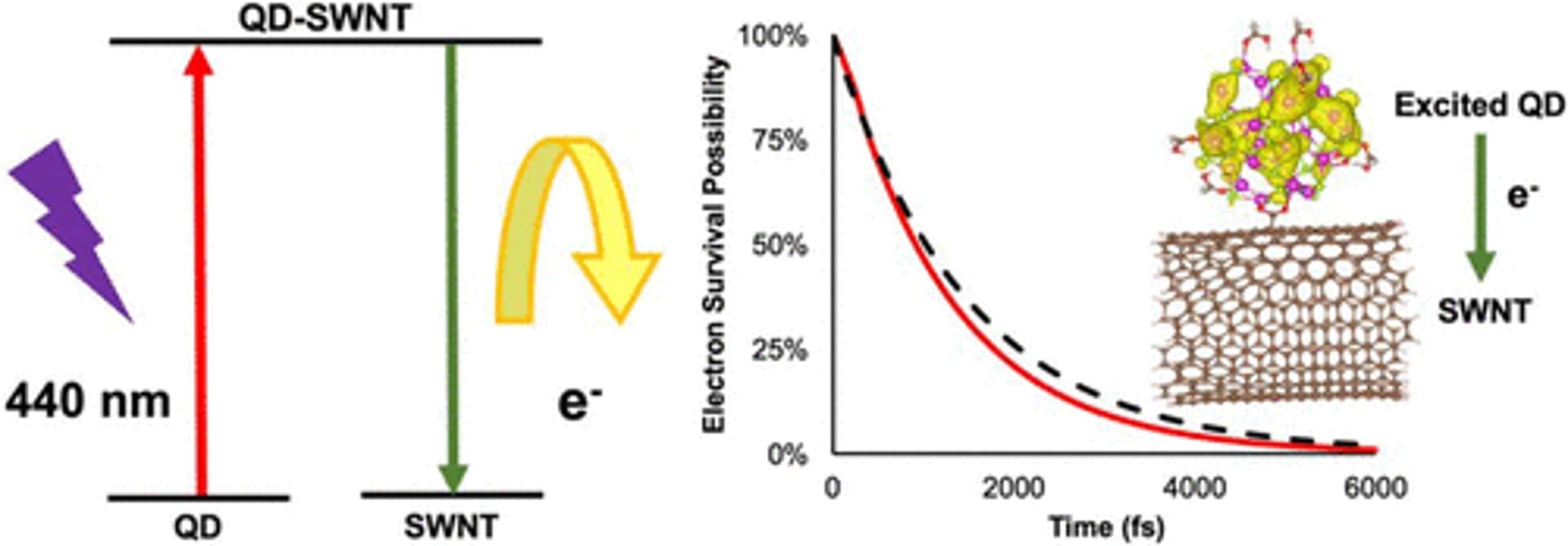
Quantum dots (QDs) and single-walled carbon nanotubes (SWNTs) have electronic and photonic properties ideally suited for applications to solar cells, catalysts, sensors, and light-emitting diodes. Many of those applications require efficient energy transfer interfacing different semiconductor nanomaterials. In this study, we develop covalently bonded interfaces to optimize charge transfer from the photoexcited QD to the carbon nanotube acceptor exploiting interfacial strong electronic coupling. Ultrafast transient absorption spectroscopy of CdSe QDs reveals considerably shorter lifetimes of electronic excited states when the QDs are covalently bonded to mildly oxidized SWNTs with surface-anchoring carboxylic acid groups. We define a set of spectroscopic fingerprints to characterize strong coupling. These include suppression of photoluminescence (PL), broadened UV-vis spectra, and transient absorption time scales faster than the picosecond timescale. Thus, the QD-SWNT assemblies were characterized by UV-visible spectroscopy, transmission electron microscopy (TEM), X-ray absorption fine structure (EXAFS), transient absorption, and photoluminescence (PL) experiments. Calculations of fully atomistic models relaxed at the density functional theory (DFT) level of theory provide a rigorous interpretation of the experiments as directly compared to the simulated Cd-edge EXAFS spectra and quantum dynamics simulations of interfacial electron transfer (IET). Charge-separated states exhibit ultrafast electron transfer from the CdSe QDs to the SWNTs due to the strong electronic coupling with negligible energy barriers for charge transport between components in the QD-SWNT nanocomposites. The experimental and theoretical calculation results consistently indicate that strong interfacial coupling fundamentally modifies the electronic structure and charge-transfer dynamics, demonstrating that the QD-SWNT assemblies cannot be regarded as a simple combination but instead a hybrid system with distinct properties.