Binding of Acetate in the S2 State of the Oxygen-Evolving Complex in Photosystem II #481
Authors
Julianne S. Lampert, Gourab Banerjee, Ipsita Ghoush, Jinchan Liu, Krystle M. Reiss, Richard J. Debus, Victor S. Batista, Gary W. Brudvig
Abstract
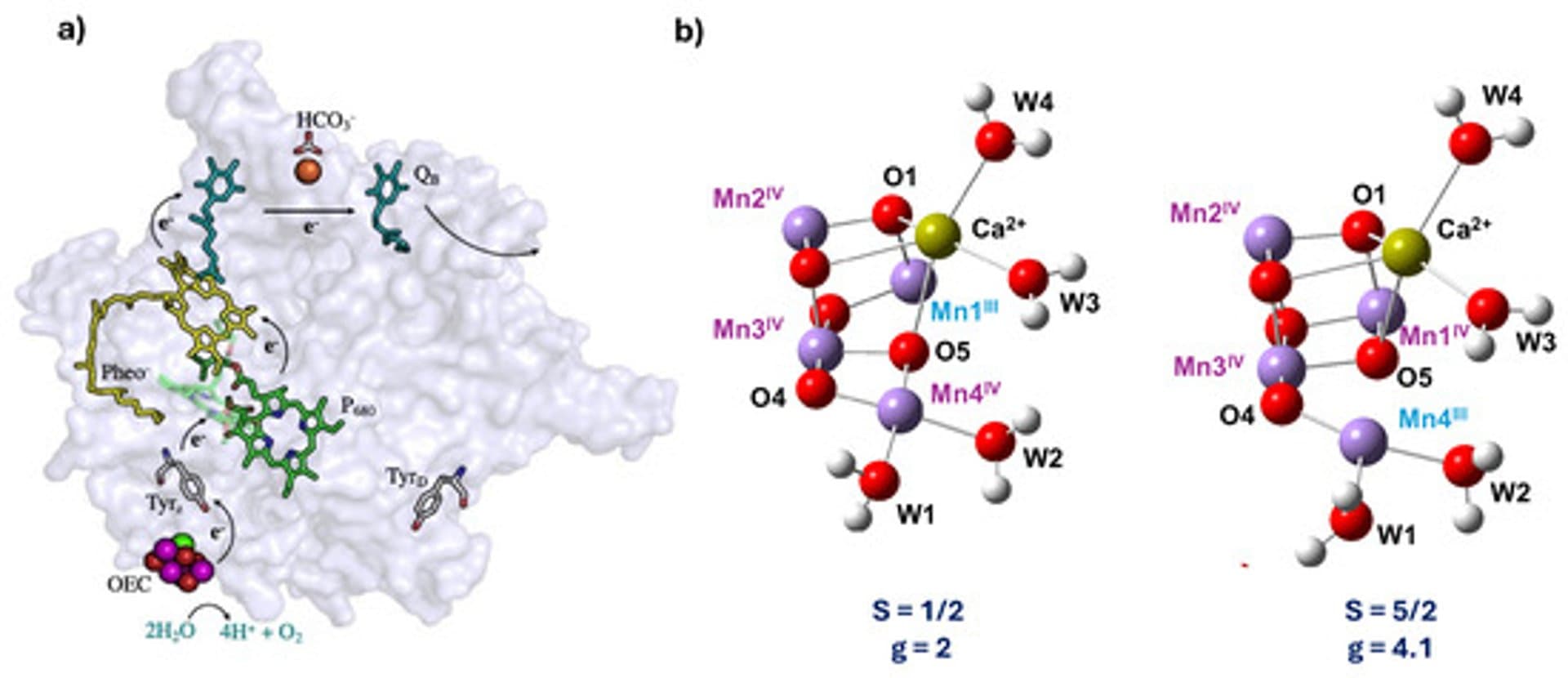
Photosynthetic water oxidation is catalyzed by the Mn4CaO5 oxygen-evolving complex (OEC) of photosystem II (PSII), where hydrogen-bonding and ion-binding networks regulate proton transfer, substrate-water delivery, and S-state advancement. Acetate binding inhibits oxygen evolution, competes with chloride, and stabilizes the 𝑆=5/2 spin isomer of the S2 state, but its donor-side binding site remains unresolved. Here, we combine EPR spectroscopy, pH-dependent oxygen-evolution measurements, mutagenesis, and QM/MM calculations to support a donor-side acetate-binding model and determine how acetate perturbs the OEC environment. Acetate increases the ratio of the 𝑔=4.1 to 𝑔=2 S2-state EPR signals in spinach PSII membranes and cyanobacterial PSII core complexes, with stronger stabilization persisting to higher pH in spinach PSII. The D1-N87A Synechocystis PSII variant exhibits spinach-like acetate sensitivity and pH-dependent oxygen-evolution behavior, with an effective acidic 𝑝𝐾𝑎 of approximately 5.3, versus 4.2 for wild-type cyanobacterial PSII, implicating long-range perturbations of the narrow-channel hydrogen-bonding network. QM/MM calculations support acetate binding near the D1-D61/W1 region, where the acetate-bound 𝑆=5/2 isomer is only 1.0 kcal mol−1 higher in free energy than the 𝑆=1/2 isomer, consistent with the observed spin-isomer equilibrium shift. These results reveal how acetate perturbs proton-transfer and chloride-binding processes in PSII.